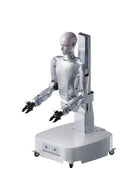
- Fixed base, 24/7 A precision workstation that turns ±90° in place and runs around the clock on direct power, with a 48 V, 18 Ah base battery fitted.
- Two 7-DoF arms About 7 kg rated and 15 kg peak payload per arm and about 0.62 m reach with a 2-finger gripper, for handling and assembly of heavy industrial components.
- From the floor to 2 m A 0.5 m lift column at up to 200 mm/s and a 2-DoF waist with 0–115° pitch reach from floor level to 2 m; robot height 1.2–1.7 m.
- Multimodal perception A wide-field humanoid binocular camera, two HD wrist cameras, and voice and natural-language interaction for intuitive human–robot collaboration.
- Built for development Intel Core i5 + Core i7 computers, SDKs, APIs and a navigation software stack, secondary development and an optional NVIDIA Jetson Thor module.
- End effectors to order A 2-finger gripper, a 3-finger or a 5-finger dexterous hand, quick-changed for industrial, commercial or research work.
- Unitree's own stack Self-developed actuators, force-controlled joints and motion-control algorithms, updated over the air; 12-month manufacturer warranty.

Description
The Unitree H2-D Standard is the fixed-base version of Unitree's H2-D: an H2-series humanoid upper body on a lift column, configured as a precision workstation. Its base turns ±90° in place, and on direct power it runs around the clock; a quick-release 48 V, 18 Ah base battery (864 Wh) is fitted as well. With 19 degrees of freedom excluding end effectors, it suits station work such as sorting, assembly and research benches.
Both versions carry the same upper body, built on the biomimetic design of Unitree's H2 series: two 7-DoF arms with about 7 kg rated and 15 kg peak payload per arm and about 0.62 m single-arm reach with a 2-finger gripper, a 2-DoF waist with 0–115° pitch, and a 2-DoF head. A lift column with 0.5 m of travel at up to 200 mm/s sets the robot's height between 1.2 and 1.7 m, and waist pitch with whole-body coordinated motion extends the workspace from floor level to 2 m. A humanoid binocular camera with a wide field of view and two HD wrist cameras give it vision, and voice and natural-language interaction make working alongside it intuitive.
An Intel Core i5 platform computer and an Intel Core i7 for custom development run on board, with secondary development supported through Unitree's SDKs, APIs and navigation software stack, and an optional high-performance module such as NVIDIA Jetson Thor. End effectors are chosen per order and quick-changed for the task: a 2-finger gripper, a 3-finger or a 5-finger dexterous hand. Unitree builds the actuators, force-controlled joints and motion-control algorithms itself and updates the robot over the air; the manufacturer warranty is 12 months.
Unitree designs the H2-D for four areas: industrial automation (high-speed sorting, autonomous warehousing), research and education (embodied-AI research and validation, robotics education, demonstrations), commercial services (reception, guided tours, retail operations) and embodied-AI development (large-scale real-world data collection, model fine-tuning, sim-to-real transfer). Keep a sufficient safety distance between people and the robot in operation.
Need it on a mobile base? See the H2-D Flagship. In the same H2 series, Unitree offers an upper body on a bench-height mounting plate (H2-A) and the full-size biped (H2).
Features
Specs
| Brand | Unitree Robotics |
|---|---|
| Model | H2-D Standard |
| Robot type | Dual-arm humanoid on a lift column, fixed base |
| Overall dimensions, column lowered | 1200 × 576 × 620 mm |
| Overall dimensions, column raised | 1700 × 576 × 620 mm |
| Weight, with battery | 135 kg |
| Degrees of freedom, excl. end effectors | 19 |
| Arms · waist · head · base | 7 + 7 · 2 · 2 · 1 |
| Lift travel · lift speed | 0.5 m · up to 200 mm/s |
| Waist pitch | 0–115° |
| Working height | From floor level to 2 m |
| Arm payload | Peak about 15 kg; rated about 7 kg (varies with the arm's extension posture) |
| Single-arm reach, 2-finger gripper | About 0.62 m |
| End effectors | 2-finger gripper, 3-finger or 5-finger dexterous hand; selected with your quotation |
| Base | Fixed base |
| Rotation · turning | ±90° in place |
| Cameras | Humanoid binocular camera, wide field of view ×1; wrist HD cameras ×2 |
| Computing | PC1 Intel Core i5 (platform) + PC2 Intel Core i7 (custom development) |
| High-performance computing module | Optional, e.g. NVIDIA Jetson Thor |
| Wi-Fi 6 · Bluetooth 5.2 | Yes |
| Battery | Quick-release base battery, 48 V, 18 Ah (864 Wh) |
| Operating time | 24/7 on direct power supply |
| Handheld controller · visualization PC | Yes · Yes |
| Intelligent OTA · secondary development | Yes · Yes |
| Warranty | 12 months |
| Interaction | Voice and natural-language interaction |
| Software | SDKs and APIs, navigation software stack, intelligent OTA updates |
| In the box | Quick-release base battery, handheld controller, visualization PC; end effectors and computing module as configured, confirmed with your quotation |
Industries
Product Brochure

Unitree H2-D Standard Fixed Base Dual-Arm Humanoid Robot – Product Brochure
The Robotix Market brochure with every capability and the full technical specification — to save, print or forward.
Download Brochure (PDF)Frequently Asked Questions
The Unitree H2-D Standard is priced on request. Contact us for current pricing and a tailored quote for your market.
The H2-D comes with its quick-release base battery, a handheld controller and a visualization PC. The end effectors and an optional high-performance computing module are configured per order; we confirm the full packing list with your quotation.
The upper body, arms, lift column, cameras and computers are the same. The Standard sits on a fixed base that turns ±90° in place and runs 24/7 on direct power (19 DoF). The Flagship drives on a differential-drive base at up to 1.5 m/s with a chassis LiDAR, depth camera, collision and ultrasonic sensors, and a 30 Ah battery for about 5 hours (20 DoF).
Unitree offers a 2-finger gripper, a 3-finger dexterous hand or a 5-finger dexterous hand, quick-changed for the task. The model and edition are selected with your quotation.
Yes. Secondary development is supported: your software runs on the Intel Core i7 development computer (and an optional high-performance module such as NVIDIA Jetson Thor), with Unitree's SDKs, APIs and navigation software stack.
The Standard runs around the clock on a direct power supply; a quick-release 48 V, 18 Ah base battery (864 Wh) is fitted as well.
Both H2-D versions carry a 12-month manufacturer warranty. Every robot ships with official documentation, and support is coordinated with Unitree's service network.
Yes. Robotix Market ships worldwide; delivery, import duties and the delivery estimate to your address are confirmed with your quotation.
Unitree H2-D Standard Fixed Base Dual-Arm Humanoid Robot
- Regular price
- Request Quote for Price
Recently Viewed
You haven't viewed any products yet.